

Note
First Step Act, August 2018: DOJ Opposed It, the White House Pushed a Deal
In August 2018, the Justice Department opposed the First Step Act, but the White House backed a Senate deal to add sentencing reform, and that deal later became law.
Written by Brandon Sample · Updated · Filed under Federal sentencing legislation
In August 2018, the Justice Department urged the White House to oppose the First Step Act. The President went the other way and backed a Senate deal to add sentencing reform to the bill. Below is what DOJ argued, why we thought it was wrong, and what the deal included.
Update (October 2026): This is a news post from August 2018. The compromise it describes did become law. The First Step Act was signed on December 21, 2018 (Pub. L. 115-391). As predicted below, only the crack cocaine fix (§ 404) applies to old sentences. The § 851 and § 924(c) changes do not. In 2025 the Supreme Court held that the § 924(c) fix does apply if an old sentence is thrown out and the person is resentenced after December 21, 2018 (Hewitt v. United States, No. 23-1002, opinion). For the law as passed, see our section-by-section summary.
In May 2018, the House passed the First Step Act 360-59, a big bipartisan vote. Since then, some on the right had called it "soft on crime." Others on the left said it did not go far enough to fix unfair sentencing. We broke down the House bill in an earlier article about the legislation.
The Justice Department opposes the First Step Act
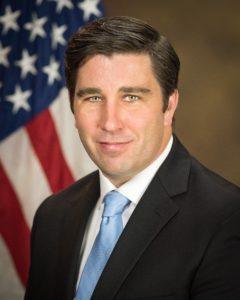
Assistant Attorney General Stephen Boyd
In July 2018, Stephen Boyd, the Justice Department's (DOJ's) Assistant Attorney General for Legislative Affairs, wrote to the White House opposing the First Step Act. The letter made these arguments:
- Courts had reduced drug sentences in recent years, and DOJ claimed drug and violent crime went up as a result.
- The bill would release prisoners too fast, a so-called "backdoor early release."
- Prisoners could earn too many time credits, for too many kinds of activities, and spend more time in the community.
- Letting prisoners earn a full 54 days of good time a year would be a "double dip." DOJ said prisoners would be "prospectively credited additional time off for years they will never actually serve because they will have already been released."
- Time credits plus the year off for finishing the Residential Drug Abuse Program (RDAP) would let too many prisoners out too quickly. DOJ said some would serve only 50 percent of their sentence.
- Too many "serious, violent criminals" would benefit.
- The bill would give "significant benefits to illegal aliens," including housing closer to U.S. relatives and early release.
- The bill would put "impossible administrative burdens" on the Bureau of Prisons (BOP), through more phone time, more halfway house use, and letting prisoners ask a court for compassionate release themselves.
In short, DOJ opposed the whole bill. Unsurprisingly, it offered no alternative beyond saying it "is working hard to improve its evidence-based-recidivism-reduction efforts to help prisoners become contributing members of society."
We think DOJ's arguments had serious flaws.
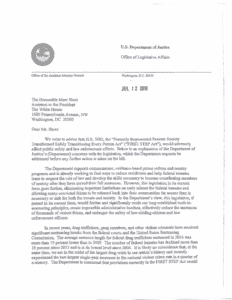
Letter from DOJ to the White House opposing the First Step Act
First, correlation is not causation. As FreedomWorks pointed out in a rebuttal, two things happening at once does not prove one caused the other. It is not fair to suggest, without more, that any rise in drug and violent crime happened because federal judges recently sentenced less harshly.
Second, people released on time credits are still in custody. They remain under BOP control in a halfway house or on home confinement. If they break the rules, they can be sent straight back to prison. In a way, the bill creates a kind of "parole light." Congress voted to abolish federal parole in 1984. Since then, "truth in sentencing" laws have caused prison populations to grow dramatically.
Third, the bill would not release large numbers of violent people. Part of the problem is how DOJ defines "violent." DOJ has long treated anyone who gets the two-level gun enhancement in a drug case as violent. But people get that enhancement for guns that were not theirs, were legally owned, or did not even work.
That is because of how the U.S. Sentencing Commission wrote the guideline. At the time, the commentary said the enhancement applies unless the defendant shows it is "clearly improbable that the weapon was connected with the offense." The burden is on the defendant, and it is an almost impossible standard for many to meet. Yes, you can get a gun enhancement for a "gun" that does not work. Sorry, DOJ, but having a gun that is not yours, or that does not work, does not make you violent.
Fourth, the immigration argument does not hold up. The House bill did let non-citizens earn early release for taking programs. But it sent them to immigration officials for deportation, not back into U.S. communities. Returning non-citizens to their home countries would save U.S. taxpayers millions of dollars in prison costs.
Fifth, the good time fix is what Congress meant all along. Congress intended people to serve about 85 percent of their sentences with good time. But because of how the BOP, which is part of DOJ, distorted its reading of the statute, people with full good time actually served no less than 87.2 percent of their sentences.
Finally, the "burden" claim is weak. The BOP gets billions of dollars a year from Congress. It already monitors inmate calls electronically, so more phone time with family would not place an undue burden on it. The same is true for the rest of the bill. In essence, DOJ's complaint comes down to its officials possibly having more work to do. In my book, that is a good thing.
The White House backs a deal to add sentencing reform
After the House vote in May, the bill stalled in the Senate. Much of the Senate opposition was because the bill did not include sentencing reform. Now, despite DOJ's opposition, the White House appears ready to add some.
On August 2, 2018, the President met with Senators Mike Lee (R-UT), Lindsey Graham (R-SC), Chuck Grassley (R-IA), and Tim Scott (R-SC), among others.
A compromise was reportedly reached that would lower the mandatory minimums for drug cases with prior convictions (21 U.S.C. § 851 enhancements) from life to 25 years, and from 20 years to 15 years.
The deal would also:
- Expand the safety valve, which lets judges go below a mandatory minimum in some drug cases
- Fix the "stacking" of gun charges under 18 U.S.C. § 924(c)
- Make the Fair Sentencing Act of 2010, which reduced crack cocaine penalties, apply to old sentences
But there is bad news for many prisoners and families. Only the Fair Sentencing Act change would apply to people already sentenced. People serving life under § 851, or "stacked" § 924(c) sentences, would not benefit.
The President reportedly supports the compromise. The Senate could vote as soon as this month, or in the lame duck session after the November election.
Facing a federal sentence? Book a consultation to talk it through with Brandon Sample.